Home/Bats
Bat Removal in Dothan
Bats are the most legally constrained animal in this trade. Getting the timing wrong is not just inhumane, it is often illegal.
Alabama’s bat rules bite hardest in exactly this kind of building stock. Agricultural buildings, older houses with big open attic volumes and metal roofs on timber framing all suit a colony, and the state’s maternity restrictions apply to all of them. Timing is the whole job: get it wrong and the exclusion is both illegal and cruel, because the young cannot fly out.
Bats are protected under both federal and Alabama state law. Removal is by
exclusion only (one-way valves) never trapping or killing.
Exclusion avoided during maternity season: reported as roughly May – July
The Alabama rules in full →
How you know it is bats
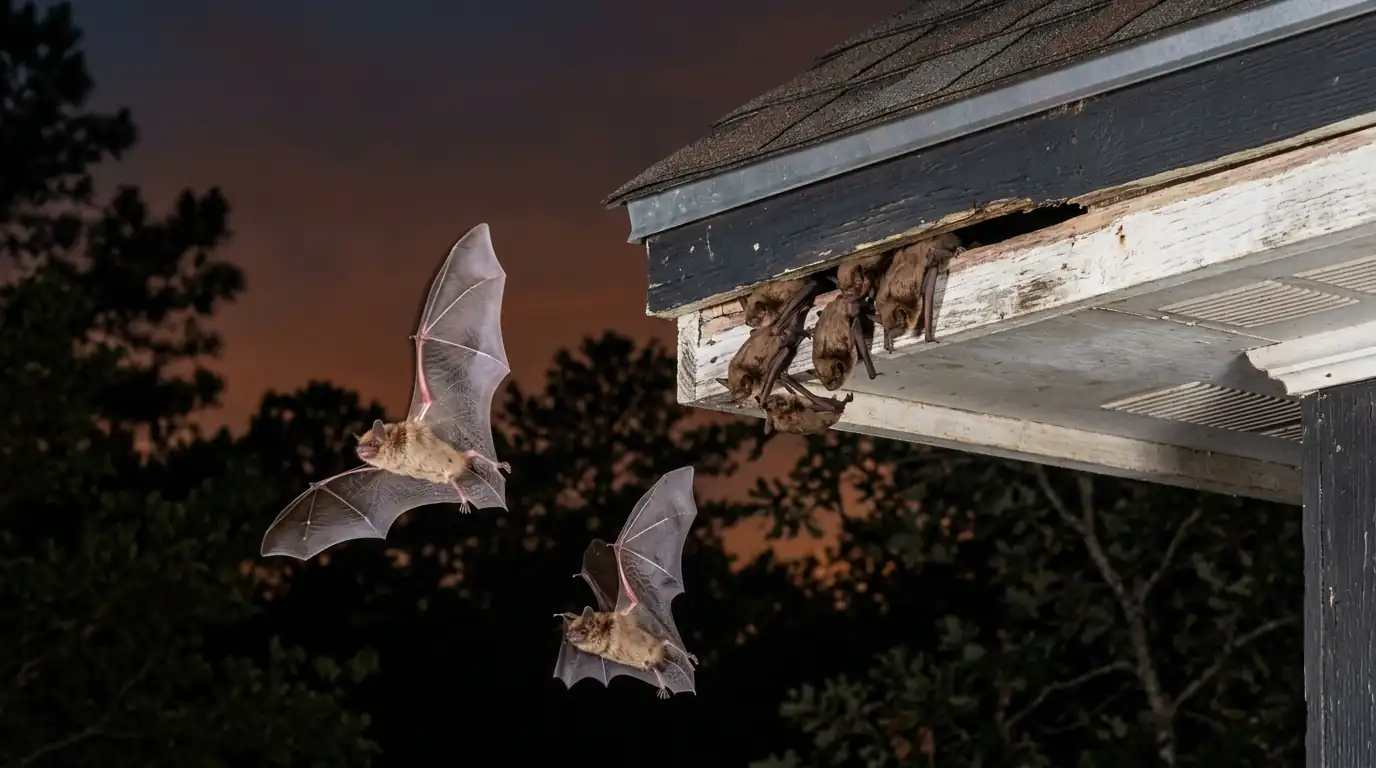
- Bats seen leaving the roofline, a gable end or a chimney around sunset
- Squeaking or rustling from a wall cavity or attic, worst on hot evenings
- A sharp ammonia smell: accumulated guano and urine
- Dark greasy staining around a gap, vent or ridge line where they squeeze through
- Guano piles below an entry point or on the attic floor
Why it matters
- Rabies: any direct contact, or a bat found in a room where someone was asleep, needs a call to your health department
- Histoplasmosis, a lung infection from fungal spores in accumulated guano
- Guano is corrosive and will damage timber, drywall and insulation over time
- Colonies grow year on year if the roost is left open
Somebody has to look at the property to answer that. How many entry points or burrows there are, how hard they are to get at, and whether young are present is what sets the price, and none of it can be judged from a description. Send us your address and licensed local operators will quote the inspection and the work. Request free quotes →
How removal actually works
Bats are never trapped or killed. A licensed operator fits one-way valves at the active exits so bats can leave but cannot re-enter, seals every other gap first, then removes the valves once the roost is empty. Guano removal and attic decontamination usually follow.
Timing
Exclusion is restricted during maternity season, when pups cannot yet fly. Sealing a roost then traps them inside to die. The dates differ by state: see the Alabama law page.
What it costs
Removal is only part of it. Where an animal has been in an attic for a while, the contaminated insulation and droppings are usually the larger bill: what attic restoration involves →
What Alabama law requires
Nuisance Wildlife Control Operators are permitted by the Alabama Division of Wildlife and Freshwater Fisheries to remove nuisance wildlife at the landowner or tenant's expense. Alabama game and fish regulation 220-2-.27 provides for permits to take protected wildlife causing crop damage, property damage, or raising concern for human safety. Full Alabama rules →
Bat questions
How much does Bat removal cost in Dothan?
$400 – $600 small colony · $500 – $1,200 typical · $5,000 – $8,500 for a large colony. The spread comes down to how many entry points there are, how hard the roof or crawlspace is to reach, and whether young are present. Anyone quoting a firm price before seeing the property is guessing.
How quickly can someone come out?
Most bats calls in Dothan are handled within a day or two. If an animal is loose inside your living space, or there is a bite or scratch involved, say so when you make contact; that changes the priority.
Can I just do it myself?
Sometimes, legally speaking. But the two things that go wrong are sealing an entry point while young are still inside, and handling an animal that turns out to be a rabies vector. Both are expensive mistakes, and one is dangerous.
Is there a wrong time of year for this?
Exclusion is restricted during maternity season, when pups cannot yet fly. Sealing a roost then traps them inside to die. The dates differ by state: see the Alabama law page.
Request free quotes
Licensed wildlife operators covering Dothan will contact you directly. There is no charge and no obligation.